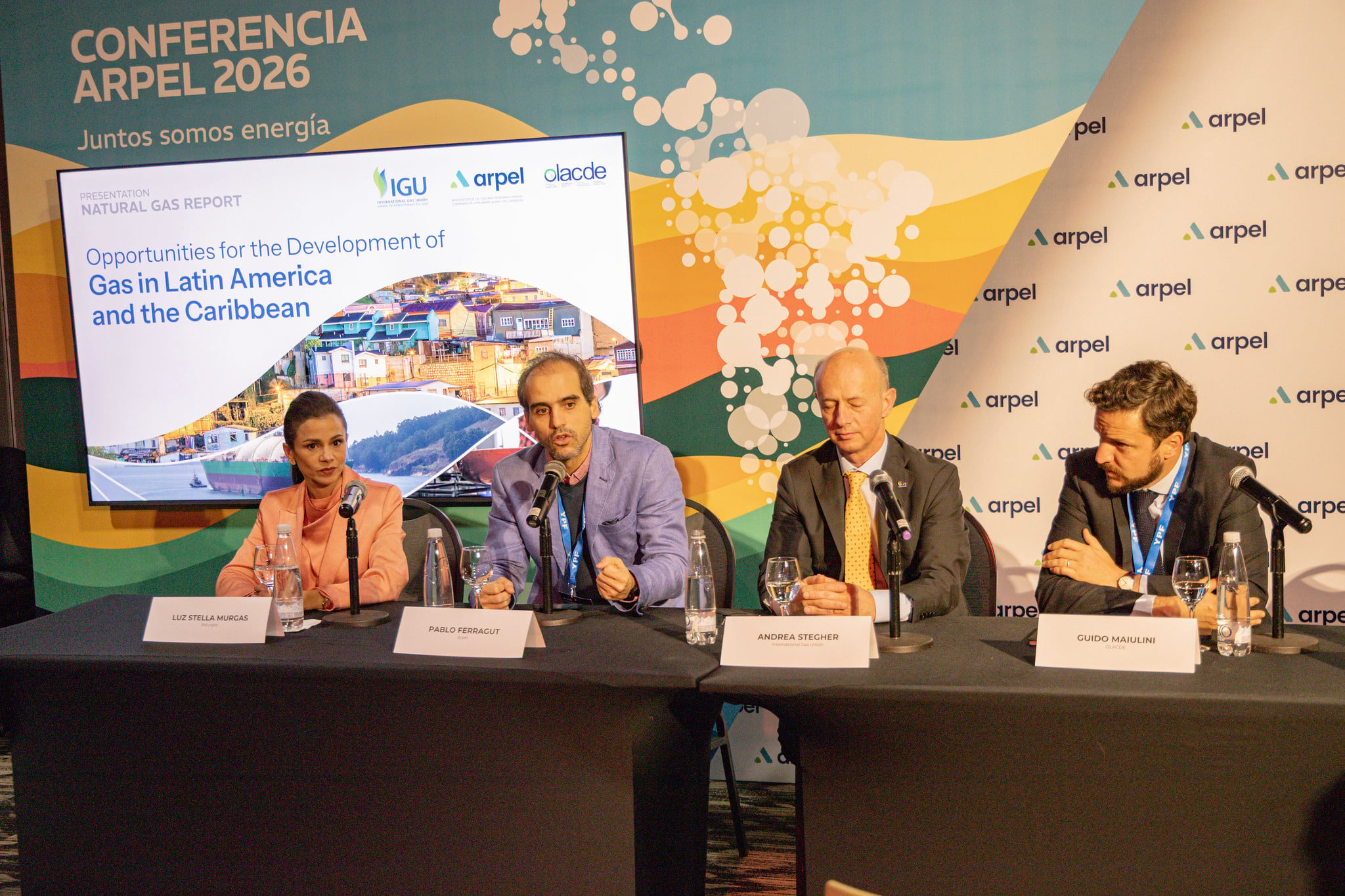
The report was jointly prepared by the International Gas Union (IGU), the Association of Oil, Gas and Renewable Energy Companies of Latin America and the Caribbean (ARPEL), and the Latin American and Caribbean Energy Organization (OLACDE).
The study highlights that Latin America and the Caribbean possess significant geological potential and vast energy resources. However, according to the report, which was unveiled on Tuesday, the region accounted for only 5% of global natural gas production in 2024. The report estimates that more than US$10 billion in investment will be required to close this gap and advance regional energy integration through the construction and expansion of cross-border gas pipeline infrastructure.
At the same time, the report warns that, in order to monetize reserves, mobilize public and private capital, and secure blended financing mechanisms and support from multilateral development banks, it is essential for legal frameworks and industry regulations to transcend political cycles and changes in government.
The report also notes that the reserves of Vaca Muerta, together with other conventional offshore projects and Brazil’s pre-salt fields, could usher in a new phase of energy expansion in the Southern Cone. These resources would complement the established production of countries such as Venezuela, Bolivia, Peru, and Trinidad and Tobago, as well as emerging exploration frontiers in Guyana and Suriname.
This development could generate direct benefits for Argentina by reducing LNG imports and increasing exports, positioning the country as a major player in the global LNG market. At the regional level, Argentine gas could support Brazil’s reindustrialization through competitive pricing, enable Bolivia to monetize its underutilized infrastructure through transit fees, and provide Chile and Uruguay with a more cost-effective alternative to imported LNG.
The Role of Natural Gas in Decarbonization
The report argues that natural gas can deliver rapid emissions reductions by replacing more carbon-intensive fuels in thermal power generation. According to the IPCC, the use of natural gas can reduce greenhouse gas emissions by approximately 24%, 28%, and 42% per unit of primary energy when replacing diesel, fuel oil, and coal in electricity generation, respectively.
In addition, natural gas serves as an essential backup for variable renewable energy sources such as solar and wind, particularly during hydrological crises. This was evident in Brazil in 2021, when gas-fired generation had to double in order to avoid power supply disruptions.
This substitution is particularly relevant in several countries across Central America and the Caribbean, where electricity systems continue to rely heavily on petroleum-derived fuels. Countries such as Grenada, Haiti, Barbados, Cuba, Nicaragua, Belize, Guyana, and Suriname depend on these liquid fuels for more than 50% of their electricity generation. In these systems, switching to natural gas can deliver immediate environmental and economic benefits without requiring major structural changes to the operation of the power system.
The Role of Natural Gas in Transport
In the heavy-duty transport sector, the shift toward Compressed Natural Gas (CNG) and Liquefied Natural Gas (LNG) can reduce emissions by approximately 20%, offering a commercially available solution to advance the decarbonization of the sector. The report notes that, while low-carbon fuels such as methanol, ammonia, and hydrogen hold significant long-term potential, both the technologies and the infrastructure required for their deployment continue to face maturity and scalability challenges.
From a supply-side perspective, monetizing the region’s natural gas reserves can drive economic growth, strengthen trade balances through increased exports and reduced imports, and support social development by expanding access to cleaner, more affordable, and reliable energy.
A clear example can be found in Colombia, where the Multidimensional Energy Poverty Index (IMPE), developed by Promigas, shows that the incidence of energy poverty declined from 16.9% to 15.4% between 2022 and 2024, representing an improvement for approximately 300,000 people and demonstrating that access to affordable energy directly improves quality of life.
In addition, the integration of renewable gases such as biomethane can strengthen local development, create income-generating opportunities in rural areas, improve waste management, and reduce emissions, while leveraging existing infrastructure.
About the Report: Opportunities for the Development of Gas in Latin America and the Caribbean
The report aims to contribute constructively to the international energy dialogue by highlighting the role that natural gas can play in supporting the region’s energy transition, strengthening energy security, and fostering sustainable socioeconomic development.
Its preparation included consultations with leading companies in the sector, national gas associations, and regional experts, reflecting a broad industry perspective on the opportunities and challenges facing the natural gas sector across the region.
Compartir en las redes


