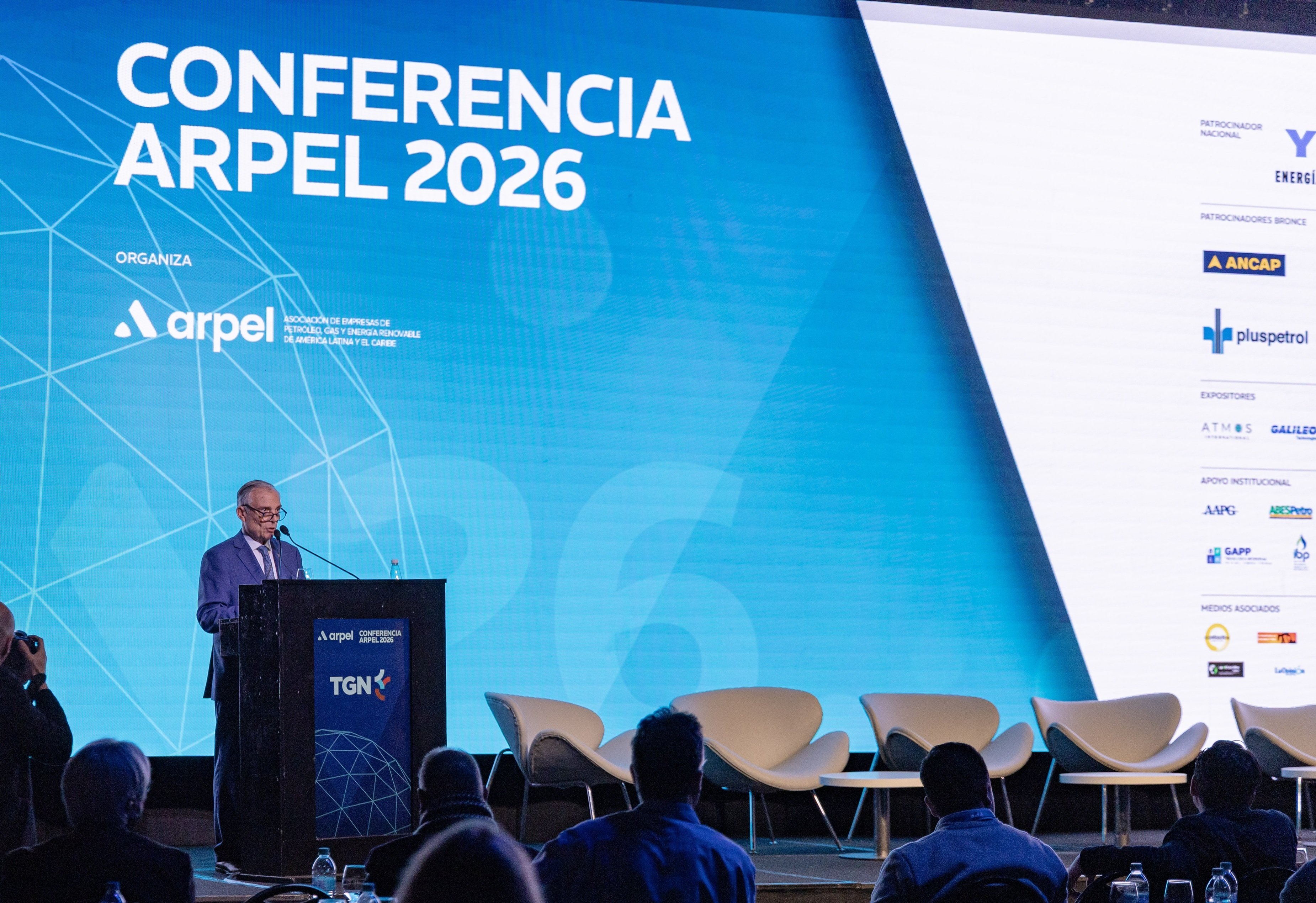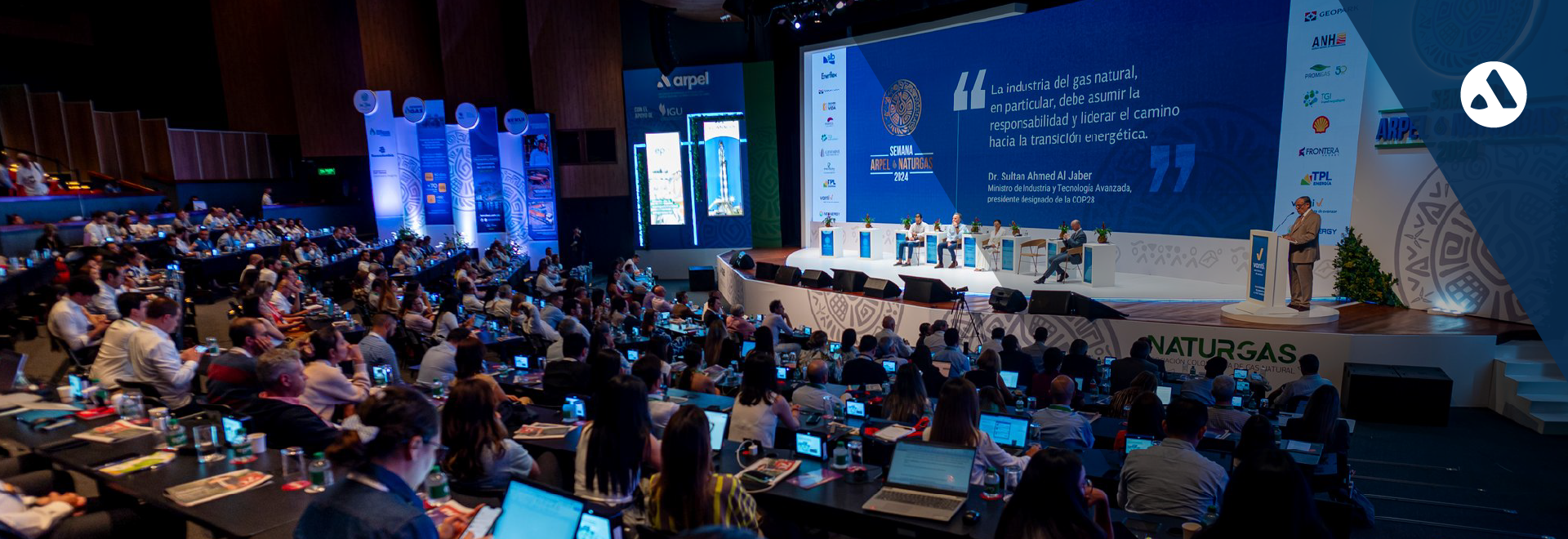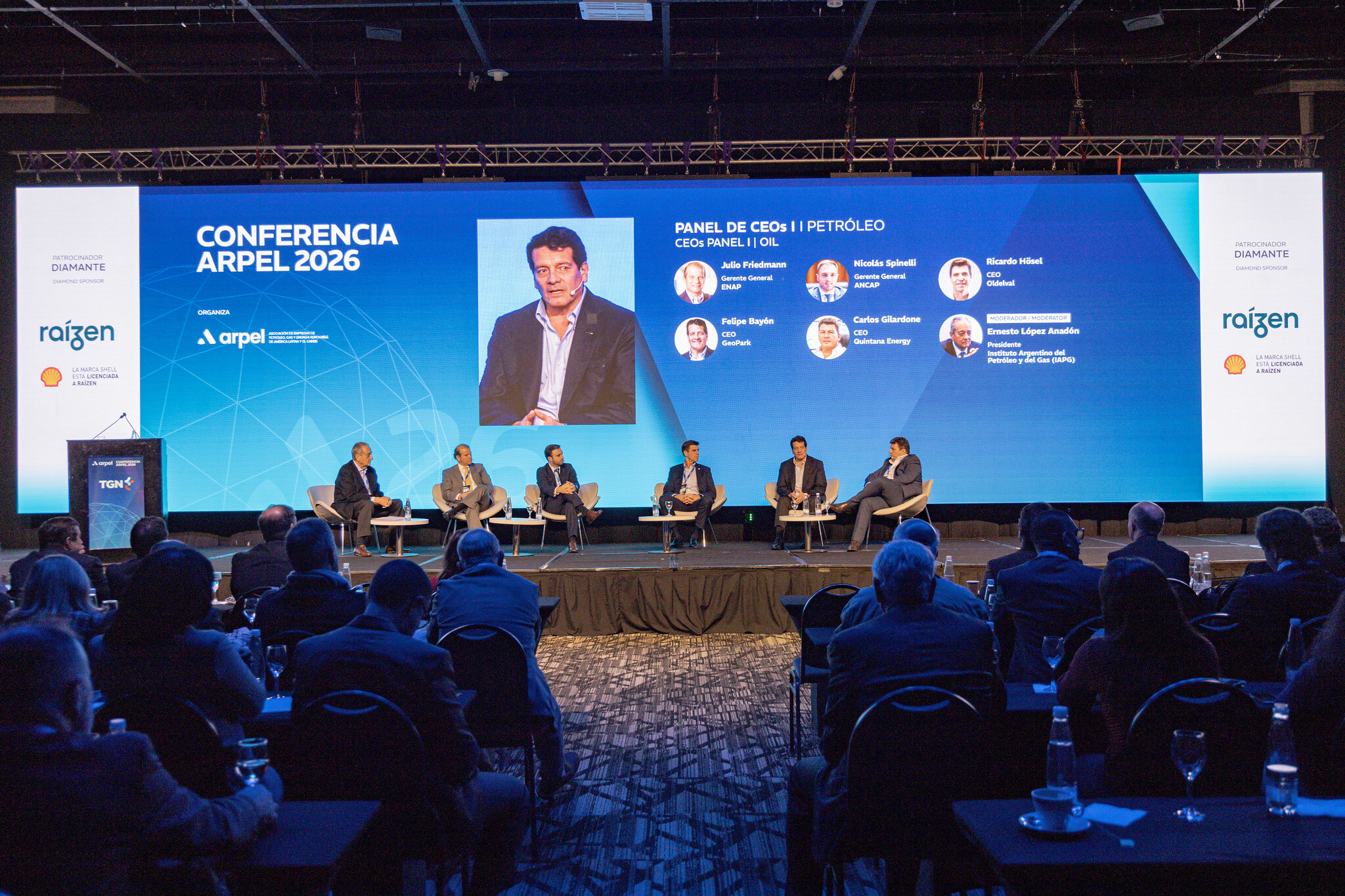
During the second day of the ARPEL Conference 2026 in Buenos Aires, the Oil CEOs Panel—featuring Julio Friedmann of ENAP, Nicolás Spinelli of ANCAP, Ricardo Hösel of Oldelval, Felipe Bayón of GeoPark, and Carlos Gilardone of Quintana Energy, and moderated by Ernesto López Anadón of IAPG—analyzed the present and future of the sector in the region. The central takeaway was that the industry is facing a period of significant opportunity, but also structural challenges that make competitiveness, infrastructure, and regulatory stability critical priorities.
Meanwhile, the Natural Gas CEOs Panel—comprising Andrés Mendizábal of TGP, Horacio Pizarro of TGN, Oscar Sardi of TGS, María Julia Aybar of Hunt Oil, Juan Manuel Rojas of Promigas, and Sergio Mengoni of TotalEnergies, and moderated by Victoria Terzaghi of Diario Río Negro—concluded that Latin America possesses abundant natural gas resources but faces the shared challenge of turning that potential into reliable supply in a global context marked by strong demand and geopolitical tensions. The executives agreed that energy security depends on advancing energy diversification, building resilience to price and supply shocks, and establishing regulatory frameworks that facilitate sustained investment.
They also emphasized that there is a tangible opportunity to position the region—and Argentina in particular—as a significant supplier on a global scale, although this will depend on infrastructure development, network expansion, and the strengthening of domestic markets. In this regard, they underscored the need to strike a balance between competition and cooperation among countries, strengthen regional integration, and view natural gas as part of an “energy addition” that will coexist with other energy sources. They highlighted that public-private coordination and regulatory stability will be key to transforming resources into economic growth and security of supply.
VACA MUERTA: A DEVELOPMENT MODEL AND A REPLICABLE CASE STUDY
The development of Argentina's shale resources is emerging as a replicable model across Latin America, amid growing global energy demand and an increasing focus on supply security. Industry representatives emphasized that the central challenge is not the availability of resources, but the ability to translate them into production through competitiveness, scale, cooperation among stakeholders, and stable regulatory frameworks that encourage investment.
The panel concluded that the expertise developed in Vaca Muerta can be applied in countries such as Mexico and Colombia, provided that conditions of stability, public-private alignment, and execution capacity are in place to turn potential into tangible results.
REFINING: SLOWER GROWTH, GREATER EFFICIENCY, AND A SHIFT TOWARD PETROCHEMICALS SHAPE THE FUTURE OF DOWNSTREAM
Refining is facing a structural slowdown after decades of expansion and is moving toward a demand plateau in a scenario where the sector will remain essential, albeit with limited growth. “They were wrong to call it an energy transition; it is an energy addition.” This was one of the central ideas to emerge from the discussion, in a global energy system that continues to depend on refining and where petrochemicals are gaining prominence as a key driver of value: “everything, including electric vehicles, relies on petrochemicals.” Against this backdrop, the main converging trends are clear: diversification of energy sources, reduced dependence on fuels such as diesel, electrification, operational efficiency, and adaptation to increasingly complex and evolving demand.
At the same time, both integrated companies and independent refiners agree that competitiveness will be determined by efficiency, selective investments, operational flexibility, and adaptability. The industry faces tighter margins, increasing regulatory pressure, and greater volatility, making it essential to maximize the value of every barrel, integrate operations, and leverage technology, data, and artificial intelligence.
ENERGY POLICIES IN THE REGION
Latin America is moving to redefine its energy policy through regulatory reform, natural gas development, and regional integration, as energy security and macroeconomic stability emerge as essential conditions for unlocking the value of its resources. There is broad consensus that natural gas serves not only as a backup source but also as a structural pillar of the energy system, while deregulation and a greater role for the private sector are emerging as key drivers of competitiveness and investment. At the same time, the region faces the challenge of translating its potential into tangible development through clear rules, long-term planning, and cooperation among countries, advancing a shared agenda in which integration is no longer optional but a decisive factor in achieving greater scale, efficiency, and relevance in the global energy landscape.

Compartir en las redes